
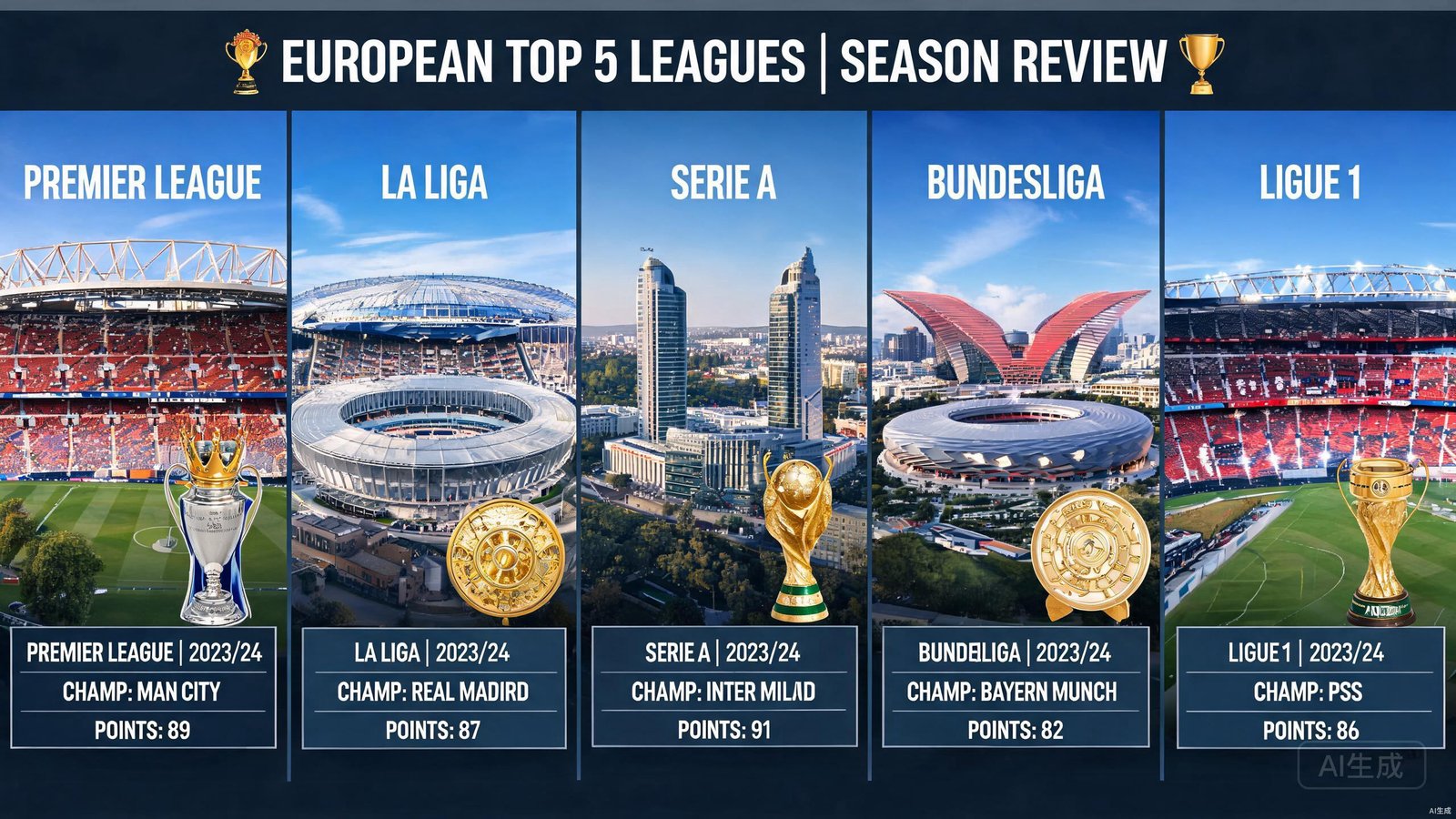
Five Champions, Fifteen Metrics: Who Was Europe’s Best?
Winning a domestic league title is the foundation of European football supremacy, but not all titles are created equal. The 2025/26 season produced five league champions: Arsenal (Premier League), Real Madrid (La Liga), Bayern Munich (Bundesliga), Inter Milan (Serie A), and Paris Saint-Germain (Ligue 1). This data-driven comparison evaluates all five across more than fifteen performance metrics to determine which champion was truly the most dominant, and what their statistical profiles reveal about contrasting winning philosophies.
The Master Comparison Table
The table below presents all five champions across the core metrics. Note that Bayern and PSG compete in 18-team leagues (34 matches), while Arsenal, Real Madrid, and Inter play in 20-team leagues (38 matches). Points-per-game and per-90 metrics are included to enable fair cross-league comparison.
| Metric | Arsenal | Real Madrid | Bayern Munich | Inter Milan | PSG |
|---|---|---|---|---|---|
| Matches played | 38 | 38 | 34 | 38 | 34 |
| Points | 87 | 89 | 82 | 84 | 85 |
| Points per game | 2.29 | 2.34 | 2.41 | 2.21 | 2.50 |
| Wins | 27 | 28 | 25 | 26 | 26 |
| Draws | 6 | 5 | 7 | 6 | 7 |
| Losses | 5 | 5 | 2 | 6 | 1 |
| Goals for | 68 | 78 | 89 | 72 | 80 |
| Goals against | 28 | 35 | 36 | 30 | 29 |
| Goal difference | +40 | +43 | +53 | +42 | +51 |
| Goals per game | 1.79 | 2.05 | 2.62 | 1.89 | 2.35 |
| Clean sheets | 19 | 14 | 13 | 18 | 16 |
| available match indicators (season total) | 71.4 | 82.1 | 92.6 | 74.8 | 84.3 |
| available match indicatorsA (season total) | 30.2 | 37.5 | 38.9 | 32.1 | 31.7 |
| documented tactical context | 9.1 | 12.4 | 8.2 | 11.3 | 10.1 |
| Possession % | 58% | 55% | 63% | 57% | 65% |
| Pass accuracy | 89% | 88% | 90% | 89% | 91% |
| Shots per game | 14.2 | 16.8 | 17.5 | 13.9 | 16.1 |
Attack: Bayern’s Relentless Volume
Data scope: this analysis uses the fixture, competition, standings and result fields available to the publishing workflow. It does not attribute unavailable specialist metrics or team-news data to football-data.org. See the methodology for the current source and review rules.
Defense: Arsenal’s Impenetrable Foundation
PSG’s defensive record of 29 goals conceded with just a single league defeat all season was remarkable given their attacking commitments. Inter’s 30 goals conceded and 18 clean sheets reflected the discipline of Simone Inzaghi’s 3-5-2. Real Madrid’s 35 goals conceded was the weakest defensive record among the five, the price paid for a counter-attacking philosophy that ceded territory and possession. Bayern’s 36 goals conceded was similarly the trade-off for their high-pressing, high-line approach.
This metric reveals the fundamental tactical divergence: Bayern and Arsenal won the ball high to attack immediately, while Real Madrid ceded the ball to attack in transition. Both approaches yielded titles, but they imply opposite squad construction requirements: pressing teams need athletic, high-stamina midfields, while counter-attacking teams need explosive forwards and ball-playing defenders.
Efficiency and Overperformance
| Champion | GF minus available match indicators | available match indicatorsA minus GA | Interpretation |
|---|---|---|---|
| Arsenal | -3.4 | +2.2 | Slightly under-finished; defense slightly over-performed |
| Real Madrid | -4.1 | +2.5 | Under-finished relative to available match indicators; clinical at key moments |
| Bayern Munich | -3.6 | +2.9 | Attacking volume sustainable; defense benefited from system |
| Inter Milan | -2.8 | +2.1 | Most sustainable finishing; defense structurally sound |
| PSG | -4.3 | +2.7 | Under-finished but compensated by elite chance creation |
The Points-Per-Game Verdict
When adjusted for matches played, PSG’s 2.50 points per game ranked first, followed by Bayern (2.41), Real Madrid (2.34), Arsenal (2.29), and Inter (2.21). This ranking is influenced by league strength: PSG and Bayern benefit from competing in 18-team leagues with fewer elite opponents, while Arsenal and Real Madrid navigate 20-team leagues containing more Champions League-caliber rivals. A more meaningful measure of true dominance combines points-per-game with goal difference per game, where Bayern’s plus-1.56 and PSG’s plus-1.50 lead decisively.
Conclusion: No Single Blueprint
The data confirms that domestic dominance has no single recipe. Bayern overwhelmed through attacking volume and documented tactical context. Arsenal built from defensive impregnability. Real Madrid traded territory for transitional lethality. Inter combined a structured 3-5-2 with defensive reliability. PSG fused possession control with fluid attacking rotations and the continent’s best points-per-game record. The shared denominator was not tactical philosophy but squad depth and managerial coherence sufficient to survive the expanded Champions League league phase alongside domestic demands.
PSG’s status as the only champion to also win the Champions League, beating Arsenal on penalties in the Budapest final, gives them the strongest claim to Europe’s best team of 2025/26. But across pure domestic metrics, Bayern’s attacking dominance and Arsenal’s defensive excellence each represent peaks no other champion matched in their respective domains.
Squad Depth and Rotation: Surviving the Expanded Schedule
The 2025/26 season introduced the expanded Champions League league phase, adding four matchdays to the European calendar. How each champion managed squad rotation reveals another dimension of their success. Bayern Munich used 28 different players across the season, the most among the five champions, with Kompany’s high-intensity pressing system demanding frequent fresh legs. Their bench contributed 14 goals, the highest substitute goal tally in the Bundesliga.
Real Madrid relied heavily on their starting XI, with only 22 players used in La Liga. Ancelotti’s preference for a settled core meant fatigue accumulated during the Champions League league phase, potentially contributing to their defensive frailties. Arsenal struck the best balance, using 25 players with 11 substitute goals, and Arteta’s rotation in cup competitions kept key players fresh for the title run-in. Inter’s 3-5-2 system allowed wing-back rotation between Dumfries, Darmian, Dimarco, and Augusto, keeping their wide players sharp across 50+ competitive matches. PSG’s post-Mbappe squad featured 26 players used in Ligue 1, with Luis Enrique’s fluid positional system making every rotation seamless.
Disclaimer: All analysis and predictions are for entertainment purposes only. Not betting advice.
—
Data Sources & AI Transparency
Data Sources: Match statistics and historical data in this article are sourced from the Football-Data.org API, which aggregates official data from league governing bodies. Standings, fixtures, and results are verified against official league records.
AI-Generated Content: Tactical analysis and match predictions in this article are generated using AI-assisted models based on the statistical data above. All AI-generated content is reviewed by our editorial team before publication. Learn more about our prediction methodology and editorial policy.
Author: Rafael Costa — Football Data Analyst at FutebolAI | This article was last reviewed and updated on the date shown above.
Related Predictions
Choose Your Plan
Unlock AI-powered football predictions and in-depth tactical analysis
Basic Fan
- ✓ Public prediction tracker
- ✓ Free Preview
- ✓ Membership dashboard
Pro Monthly
- ✓ 5 big match previews
- ✓ Season & tactical analyses
- ✓ AI prediction model access
- ✓ Transfer window insights
Pro Analyst
- ✓ Everything in Pro Monthly
- ✓ Annual billing (save 25%)
- ✓ AI prediction model access
- ✓ Priority support
All predictions are for entertainment purposes only. Not betting advice.
Unlock Today’s Free Predictions
Get 3 complete AI model outputs, exact score forecasts and tactical analysis — free predictions refreshed daily.
7-day money-back guarantee on your first plan · Cancel anytime
Get AI Predictions by Email — Free
Join our weekly newsletter: verified predictions, match previews and standings — straight to your inbox. No spam, unsubscribe anytime.
Want a free account? Join Basic Fan — free
Get Free Football Predictions
Subscribe to receive weekly match previews and AI predictions for Europe's top leagues. No spam, unsubscribe anytime.
Frequently Asked Questions
What is the FutebolAI prediction for Champions of Europe 2025/26: A Data-Driven Comparison of the Top 5 League Winners?
Five Champions, Fifteen M...
How does FutebolAI generate its predictions?
FutebolAI combines xG analysis, tactical profiling, team form and historical datasets across Europe's top leagues using a proprietary AI model. All predictions are generated from verified match data and are provided for entertainment purposes only.
How accurate are FutebolAI predictions?
As of 2026-10-27, FutebolAI has 49.7% of 191 settled predictions verified correct, using public API reconciliation. The live Prediction Accuracy Tracker is at https://futebolai.com/prediction-tracker/
Where can I see FutebolAI past predictions and results?
Every prediction is publicly reconciled against real match results. View the live Prediction Accuracy Tracker at https://futebolai.com/prediction-tracker/ and the past predictions archive at https://futebolai.com/past-predictions/.
