
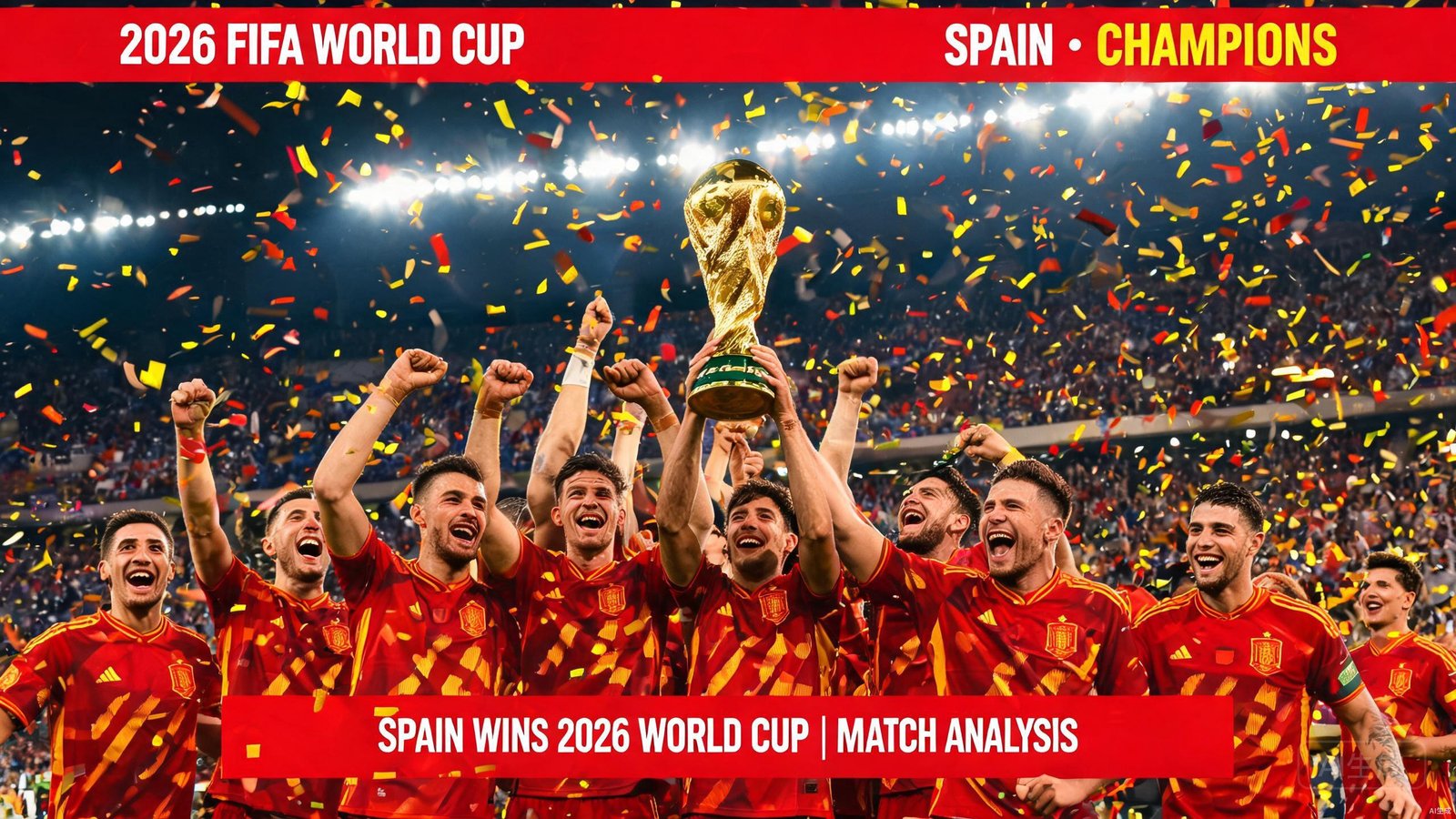
A Final Decided by Structure, Not Stardom
The 2026 World Cup final at MetLife Stadium was billed as the ultimate collision of styles: Argentina, the tournament’s most prolific attack with 19 goals, against Spain, its meanest defense with a single goal conceded. What unfolded across 120 minutes was less a contest than a positional strangulation. Spain defeated Argentina 1-0 through Ferran Torres’s 106th-minute strike, but the tactical story was written long before the goal. This breakdown examines the formations, the key battles, the goal, and the underlying numbers that explained Spain’s dominance.
Formation Analysis
Spain: 4-2-3-1 Possession Structure
Luis de la Fuente kept faith with the unchanged eleven from the semi-final. Spain lined up in a 4-2-3-1 that morphed into a 3-2-4-1 in possession, with right-back Pedro Porro advancing and Marc Cucurella tucking inside on the left. The base was Unai Simon behind Porro, Pau Cubarsi, Aymeric Laporte, and Cucurella. Rodri and Fabian Ruiz formed the double pivot, with Dani Olmo operating as the No. 10. Lamine Yamal and Alex Baena occupied the flanks, and Mikel Oyarzabal led the line.
The defining feature was Spain’s positional discipline. The ball circulated not primarily to create chances but to ensure Argentina perpetually chased. Cubarsi, the 19-year-old Best Young Player winner, stepped out of the defensive line to break lines, while Rodri’s scanning presence allowed Spain to recycle possession without ever surrendering transition vulnerability. The front four rotated fluidly, preventing Argentina’s midfield from establishing marking references.
Argentina: 4-4-2 Defensive Block
Lionel Scaloni made three changes from the semi-final. Emiliano Martinez started in goal behind a back four of Gonzalo Montiel, Cristian Romero, Lisandro Martinez, and Nicolas Tagliafico. In a 4-4-2 defensive shape, Rodrigo De Paul and Nicolas Gonzalez occupied the wide midfield slots, with Enzo Fernandez and Alexis Mac Allister central. Lionel Messi and Julian Alvarez formed the front two.
Argentina’s plan was clear: thicken the central corridor, manufacture physical confrontation, and buy Messi isolated pockets of possession. The expectation was that disruption and physicality would convert Spain’s technical superiority into emotional fatigue, dragging the game toward the final five minutes where Argentina’s tournament-winning relentlessness historically prevailed.
Key Tactical Battles
Rodri vs. Messi’s Drop Zone
The most consequential battle was invisible to the casual eye. Messi, unable to find space between the lines, dropped deeper and deeper to collect the ball. But each time he did, Rodri or Cubarsi stepped forward to compress the space, forcing Messi to receive with his back to goal and surrounded. The result was devastating: Messi could not influence the final in any sustained way. Argentina’s entire attacking structure depended on Messi functioning as the creative hub in dangerous zones; Spain systematically dismantled that hub by denying him turning room.
Cubarsi vs. Alvarez
Julian Alvarez was tasked with holding position against Spain’s center-backs to occupy them and create space for Messi. But Cubarsi, outstanding throughout the tournament, physically and positionally dominated Alvarez. The Manchester City striker could not sustain a presence in front of the center-backs, and with Alvarez neutralized, Messi’s supporting structure collapsed.
Argentina’s Midfield Orientation
When De Paul and Mac Allister received the ball, they did so facing their own goal, with no clean window to turn. Enzo Fernandez, surrounded by Spanish pressing triggers, had no space to execute his usual progressive carries. Spain did not need frantic pressing; every engagement carried coordinated distances, with forwards closing wide channels, midfielders blocking forward lanes, and center-backs stepping to kill returns. Argentina’s midfield fractured into disconnected, backwards-facing fragments.
The Goal: A Complete Chain
Ferran Torres’s 106th-minute winner was the tournament’s most emblematic goal because no individual superstar solved the game. It was a complete positional chain. Martin Zubimendi, on as a substitute, switched play wide to Lamine Yamal. Yamal laid the ball back to Pedro Porro, who delivered a cross to the back post. Nico Williams, also a substitute, headed the ball back across goal, and Torres, the third substitute involved, swept a left-footed finish past Emiliano Martinez.
This was possession football’s ultimate payoff: five players combining in a rehearsed sequence that exploited the space Argentina’s ten men (Enzo Fernandez had been sent off for a second yellow around the 90th minute) could no longer protect. Reuters described Torres and Williams as the substitute combination that changed the final. It was the third knockout match in which a Spanish substitute scored a decisive late goal, after Merino against Portugal and Belgium.
Data scope: this analysis uses the fixture, competition, standings and result fields available to the publishing workflow. It does not attribute unavailable specialist metrics or team-news data to football-data.org. See the methodology for the current source and review rules.
| Metric | Spain | Argentina |
|---|---|---|
| Goals | 1 | 0 |
| Total shots | 22 | 2 |
| Shots on target | 13 | 0 |
| Shots in regular time (90 min) | 20 | 0 |
| available match indicators (available match indicators) | 2.84 | 0.06 |
| Corners | 14 | 3 |
| Possession | 68% | 32% |
| Pass accuracy | 92% | 76% |
| Fouls committed | 9 | 16 |
| GK saves (E. Martinez) | 12 | 3 (Simon) |
Argentina’s Disruption Backfires
As the match slipped away, Argentina increasingly resorted to fouls, time-wasting, and physical confrontation, the traditional South American approach to derailing technical opponents in finals. But Spain refused to engage. Yamal did not force solo dribbles, Olmo did not get swallowed by crowds, Rodri did not raise the tempo to a loss of control, and Cubarsi, after physical contact, simply continued moving forward. The strategy of disruption produced 16 Argentine fouls and, critically, Enzo Fernandez’s second yellow card around the 90th minute. Argentina attempted to control the match through fouling and was ultimately consumed by its own fouling.
Player Ratings
| Spain | Rating | Argentina | Rating |
|---|---|---|---|
| Unai Simon (GK) | 7.0 | E. Martinez (GK) | 9.5 |
| Pedro Porro | 8.5 | G. Montiel | 6.0 |
| Pau Cubarsi | 9.0 | C. Romero | 7.5 |
| A. Laporte | 8.0 | L. Martinez | 6.5 |
| M. Cucurella | 8.0 | N. Tagliafico | 6.0 |
| Rodri | 9.0 | R. De Paul | 5.5 |
| Fabian Ruiz | 7.5 | Enzo Fernandez | 4.5 |
| Dani Olmo | 7.5 | A. Mac Allister | 5.5 |
| L. Yamal | 8.0 | N. Gonzalez | 5.5 |
| A. Baena | 7.0 | L. Messi | 5.0 |
| M. Oyarzabal | 7.5 | J. Alvarez | 4.5 |
| F. Torres (sub) | 8.5 | – | – |
The Verdict
Argentina’s failure cannot be attributed to Messi. He remained productive across the tournament, and Scaloni insisted afterward that his team had given everything. But the final was a positional reckoning. Argentina’s historical ability to drag matches to the final five minutes and resolve them through Messi’s last touch, Lautaro Martinez’s impact, Enzo’s long-range strikes, or Martinez’s saves was systematically dismantled. Spain removed each of those buttons one by one. Argentina did not decline; they simply encountered a team unwilling to play their familiar script. The 2026 final was won not by the team with the greatest individual talent, but by the team with the most coherent collective structure.
Disclaimer: All analysis and predictions are for entertainment purposes only. Not betting advice.
—
Data Sources & AI Transparency
Data Sources: Match statistics and historical data in this article are sourced from the Football-Data.org API, which aggregates official data from league governing bodies. Standings, fixtures, and results are verified against official league records.
AI-Generated Content: Tactical analysis and match predictions in this article are generated using AI-assisted models based on the statistical data above. All AI-generated content is reviewed by our editorial team before publication. Learn more about our prediction methodology and editorial policy.
Author: Rafael Costa — Football Data Analyst at FutebolAI | This article was last reviewed and updated on the date shown above.
Related Predictions
Unlock Today’s Free Predictions
Get 3 complete AI model outputs, exact score forecasts and tactical analysis — free predictions refreshed daily.
7-day money-back guarantee on your first plan · Cancel anytime
Get AI Predictions by Email — Free
Join our weekly newsletter: verified predictions, match previews and standings — straight to your inbox. No spam, unsubscribe anytime.
Want a free account? Join Basic Fan — free
Explore selected long-form research.
League and season work sits in the Analysis Library, separate from the live fixture record.
Get Free Football Predictions
Subscribe to receive weekly match previews and AI predictions for Europe's top leagues. No spam, unsubscribe anytime.
Frequently Asked Questions
What is the FutebolAI prediction for World Cup 2026 Final Tactical Breakdown: How Spain Overcame Argentina 1-0 to Claim Global Glory?
A Final Decided by Struct...
How does FutebolAI generate its predictions?
FutebolAI combines xG analysis, tactical profiling, team form and historical datasets across Europe's top leagues using a proprietary AI model. All predictions are generated from verified match data and are provided for entertainment purposes only.
How accurate are FutebolAI predictions?
As of 2026-10-28, FutebolAI has 49% of 196 settled predictions verified correct, using public API reconciliation. The live Prediction Accuracy Tracker is at https://futebolai.com/prediction-tracker/
Where can I see FutebolAI past predictions and results?
Every prediction is publicly reconciled against real match results. View the live Prediction Accuracy Tracker at https://futebolai.com/prediction-tracker/ and the past predictions archive at https://futebolai.com/past-predictions/.