
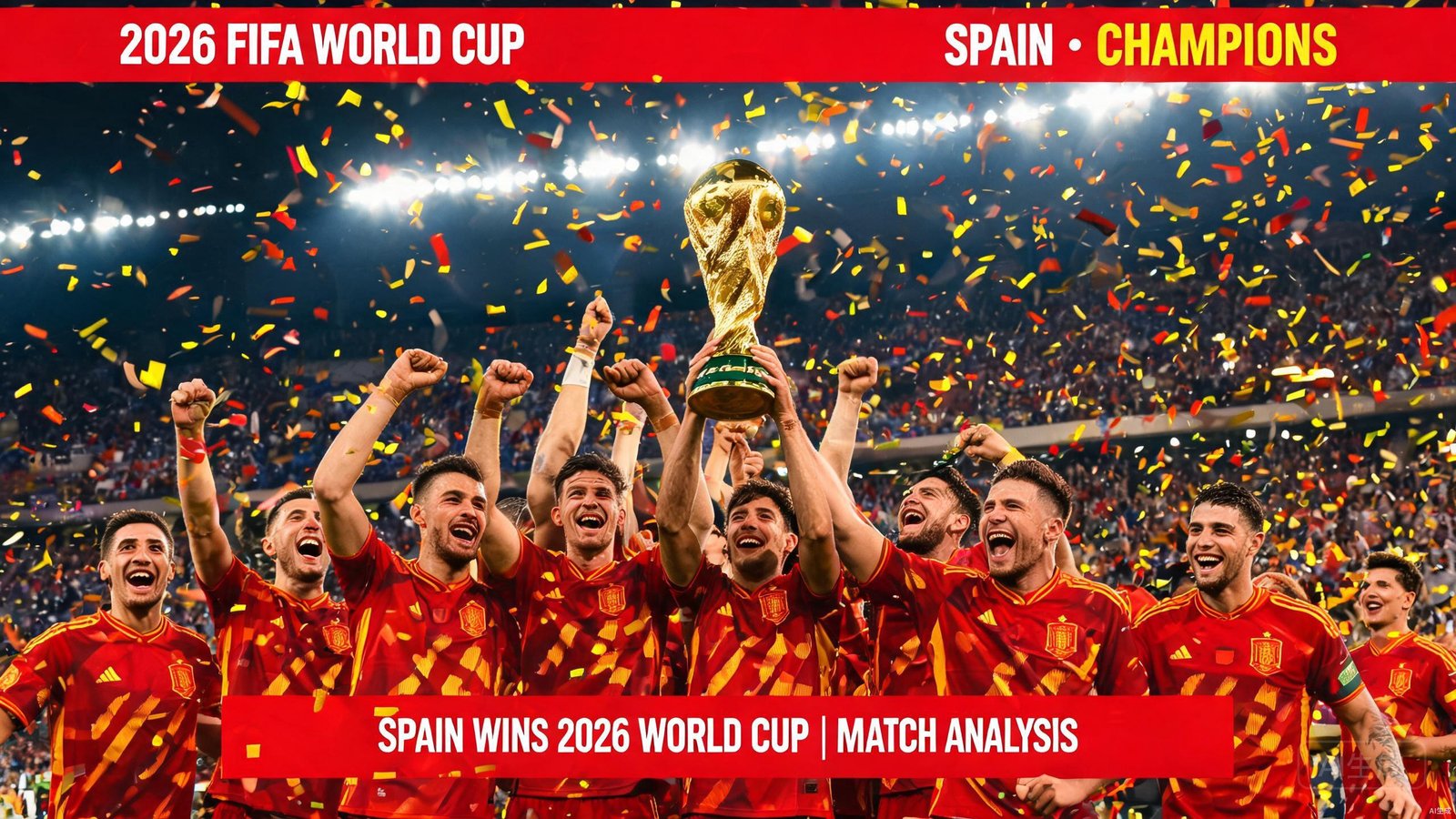
Spain Conquer the World: A 16-Year Wait Ends in New Jersey
On the night of July 19, 2026, inside a sold-out MetLife Stadium in New Jersey, Ferran Torres met a cutback at the back post and swept a left-footed finish beyond Emiliano Martinez. One hundred and six minutes had elapsed. The goal gave Spain a 1-0 extra-time victory over defending champions Argentina and delivered La Roja their second FIFA World Cup title, their first since Andres Iniesta’s strike in Johannesburg sixteen summers earlier. Spain became the first nation in history to hold both the men’s and women’s World Cup trophies simultaneously, having won the women’s edition in 2023.
The 2026 tournament was the largest in history: 48 teams, 104 matches, staged across the United States, Canada, and Mexico. Twelve groups of four fed into an expanded Round of 32, rewarding consistency over a grueling six-week marathon. What follows is the complete story of how Luis de la Fuente’s squad navigated that marathon, conceding just once in eight matches to set an all-time World Cup record for the fewest goals shipped by a champion.
Tournament Format and Context
The expanded format meant more entry points but the same narrow exit. Group-stage surprise results could reward a single heroic performance, but the knockout phase demanded relentless stability across squad depth, tactical execution, psychological resilience, and injury management. Spain arrived as European champions, unbeaten in their previous 37 matches, but their opening display suggested vulnerability rather than dominance.
Spain’s Group-Stage Journey
Spain were drawn into Group D alongside World Cup debutants Cape Verde, Saudi Arabia, and two-time champions Uruguay. The campaign opened with a frustrating 0-0 draw against Cape Verde on June 15. Spain monopolized possession but lacked a penalty-box focal point; Ferran Torres saw a close-range effort saved by goalkeeper Vozinha, and Cape Verde’s low block plus outstanding goalkeeping reduced the European champions to sterile circulation.
The breakthrough came in the second fixture, a 4-0 demolition of Saudi Arabia on June 21. Lamine Yamal announced himself on the World Cup stage with a goal ten minutes into his first start, and Mikel Oyarzabal struck twice inside the opening 25 minutes as Spain shifted from cautious possession to rapid wide insertions and back-post runs. A 1-0 win over Uruguay on June 26, settled by Alex Baena’s goal from a Fernando Muslera error, confirmed top spot with seven points and sent Uruguay home without a single victory.
The Knockout Gauntlet
Spain’s route through the knockouts revealed a team that grew sharper with every round. The Round of 32 produced a 3-0 win over Austria, with Oyarzabal scoring twice and Pedro Porro adding a third. For the first time Spain linked possession protection to defensive aggression as a complete chain: center-backs stepped high, full-backs took turns overlapping, Rodri screened the second balls, and the front line collapsed inward immediately after losing possession.
The Round of 16 against Portugal was settled in the 91st minute. Substitute Mikel Merino arrived in the box to score a late winner that simultaneously ended Cristiano Ronaldo’s World Cup career. It was the moment Spain’s bench transformed from a rotation resource into a tactical weapon. Portugal’s defense had resisted Spain’s starters but could not cope with the sudden increase in vertical box running introduced by the substitutes.
The quarter-final against Belgium was Spain’s only moment of genuine peril, and their only goal conceded in the entire tournament. Fabian Ruiz put Spain ahead on 30 minutes before Charles De Ketelaere equalized on 41. With Thibaut Courtois withdrawn through injury and Youri Tielemans hurt during the warm-up, Belgium’s personnel chain fractured. In the 88th minute, substitute goalkeeper Senne Lammens spilled a shot and Merino reacted fastest to convert the rebound for a 2-1 win.
The semi-final was Spain’s defining performance. A 2-0 victory over France, courtesy of goals from Oyarzabal and Porro, was described by Reuters as an “anaconda grip” that gradually suffocated the tournament’s most dangerous attack. Kylian Mbappe, Michael Olise, and France’s explosive wing play were starved of space; Les Bleus managed only two shots on target, and Didier Deschamps conceded afterward that his side had been technically inferior. This was the match that separated the 2026 champions from the 2010 vintage. Where Xavi, Iniesta, and Busquets wove their passing web to dictate tempo, De la Fuente’s side added a sharper defensive edge, the ball circulating not merely to find attack but to ensure opponents forever chased the game.
The Final: Spain 1-0 Argentina (AET)
The final pitted the tournament’s best attack against its best defense. Argentina arrived having won every match and scored 19 goals; Spain had conceded once and carried a 37-match unbeaten run. The contrast could not have been starker. Argentina’s starting eleven featured Emiliano Martinez behind a back four of Gonzalo Montiel, Cristian Romero, Lisandro Martinez, and Nicolas Tagliafico, with Rodrigo De Paul, Enzo Fernandez, Alexis Mac Allister, and Nicolas Gonzalez in midfield supporting Lionel Messi and Julian Alvarez.
Spain’s XI was unchanged from the semi-final: Unai Simon; Porro, Pau Cubarsi, Aymeric Laporte, Marc Cucurella; Rodri, Fabian Ruiz, Dani Olmo; Yamal, Baena, Oyarzabal. The match became a positional strangulation. Spain racked up 20 shots before Argentina registered their first attempt, won nine of the first ten corners, and forced Emiliano Martinez into a World Cup final record of 12 saves. Argentina did not manage a single shot in regular time. Messi dropped deeper and deeper to find the ball; Alvarez could not hold position against the center-backs; De Paul and Mac Allister received possession facing their own goal.
Argentina’s attempts to disrupt Spain through fouls and physicality backfired when Enzo Fernandez received a second yellow card around the 90th minute. In the 106th minute, Spain scored the winner in the most emblematic fashion possible: Martin Zubimendi switched play to Yamal, Yamal laid it back to Porro, Porro crossed, Nico Williams headed back across goal, and Torres swept home left-footed. No superstar solved the game alone; it was a complete chain of possession, the product of a system refined over years.
Individual Awards and Statistical Records
| Award | Winner | Detail |
|---|---|---|
| Golden Ball (Best Player) | Rodri (Spain) | Tournament conductor; controlled tempo in every match |
| Golden Boot (Top Scorer) | Kylian Mbappe (France) | 10 goals, 4 assists; 22 career World Cup goals (all-time record) |
| Golden Glove (Best GK) | Unai Simon (Spain) | 7 clean sheets; 1 goal conceded in 8 matches |
| Best Young Player | Pau Cubarsi (Spain) | 19-year-old center-back; defensive anchor |
Spain’s defensive record was the tournament’s defining statistic. One goal conceded across eight matches broke the previous World Cup champion record and underscored a collective defensive structure in which Simon was rarely required to make miraculous saves because the danger was choked off before it materialized. Notably, this was the first Spain World Cup squad in history to contain no Real Madrid players, a reflection of the Barcelona-Athletic Billet-Shakhtar-heavy generation that De la Fuente had nurtured through the youth ranks.
The Substitution Masterclass
A recurring theme of Spain’s campaign was the decisive impact of substitutes. Merino scored late winners against both Portugal and Belgium; Torres and Williams combined for the final’s decisive goal. Three knockout-stage goals that effectively decided Spain’s fate all originated from the bench. This was no accident but a reflection of De la Fuente’s long-standing familiarity with these players from his years coaching Spain’s youth teams. Starters knew exactly how space would be redistributed when substitutes entered; substitutes understood they needed only to complete the structure rather than prove themselves. In a format that punishes single-point dependency across six weeks, Spain’s multi-centered system proved the ultimate advantage.
What This Title Means
Spain’s 2026 triumph confirmed a generational shift. At 65, De la Fuente became the oldest man to manage a World Cup-winning side, his methods validated after Euro 2024 glory. The tournament also marked a poignant farewell: Messi walked past the trophy he could not retain, possibly for the final time, while Ronaldo’s World Cup career had ended weeks earlier in the Round of 16. Spain did not merely win a tournament; they demonstrated that a system, repeated correctly under pressure, can overcome even the most storied individual brilliance. The ball worshipped by La Roja delivered glory once more.
Tournament Statistical Summary
| Statistic | 2026 World Cup | 2022 World Cup | Change |
|---|---|---|---|
| Total Goals | 172 | 147 | +17% |
| Goals Per Match | 2.68 | 2.30 | +16.5% |
| Avg Possession (Winners) | 56% | 53% | +3pp |
| Clean Sheets | 38 | 42 | -9.5% |
| Penalties Awarded | 23 | 19 | +21% |
| VAR Interventions | 47 | 39 | +20.5% |
| Avg Pass Accuracy | 85.2% | 84.1% | +1.1pp |
Disclaimer: All analysis and predictions are for entertainment purposes only. Not betting advice.
—
Data Sources & AI Transparency
Data Sources: Match statistics and historical data in this article are sourced from the Football-Data.org API, which aggregates official data from league governing bodies. Standings, fixtures, and results are verified against official league records.
AI-Generated Content: Tactical analysis and match predictions in this article are generated using AI-assisted models based on the statistical data above. All AI-generated content is reviewed by our editorial team before publication. Learn more about our prediction methodology and editorial policy.
Author: Rafael Costa — Football Data Analyst at FutebolAI | This article was last reviewed and updated on the date shown above.
Related Predictions
Get AI Predictions by Email — Free
Join our weekly newsletter: verified predictions, match previews and standings — straight to your inbox. No spam, unsubscribe anytime.
Want a free account? Join Basic Fan — free
This match has been settled.
The original forecast remains visible. Check the final result and the wider record in the public tracker.
Settled · Forecast · Final ·
Get Free Football Predictions
Subscribe to receive weekly match previews and AI predictions for Europe's top leagues. No spam, unsubscribe anytime.
Frequently Asked Questions
What is the FutebolAI prediction for Spain Win the 2026 World Cup: Complete Tournament Review and Final Analysis?
Spain Conquer the World: ...
How does FutebolAI generate its predictions?
FutebolAI combines xG analysis, tactical profiling, team form and historical datasets across Europe's top leagues using a proprietary AI model. All predictions are generated from verified match data and are provided for entertainment purposes only.
How accurate are FutebolAI predictions?
As of 2026-10-28, FutebolAI has 49% of 196 settled predictions verified correct, using public API reconciliation. The live Prediction Accuracy Tracker is at https://futebolai.com/prediction-tracker/
Where can I see FutebolAI past predictions and results?
Every prediction is publicly reconciled against real match results. View the live Prediction Accuracy Tracker at https://futebolai.com/prediction-tracker/ and the past predictions archive at https://futebolai.com/past-predictions/.